Anatomy hub
Hip: Options and What the Evidence Actually Shows
Hip osteoarthritis and avascular necrosis (AVN) are distinct problems. OA is common; early AVN is a cleaner mechanistic case for regenerative discussion.
Where are you in this?
Same page, different emphasis. Now-path goes to the ladder and providers; ahead-path goes to banking younger cells.
Anatomy and clinical context
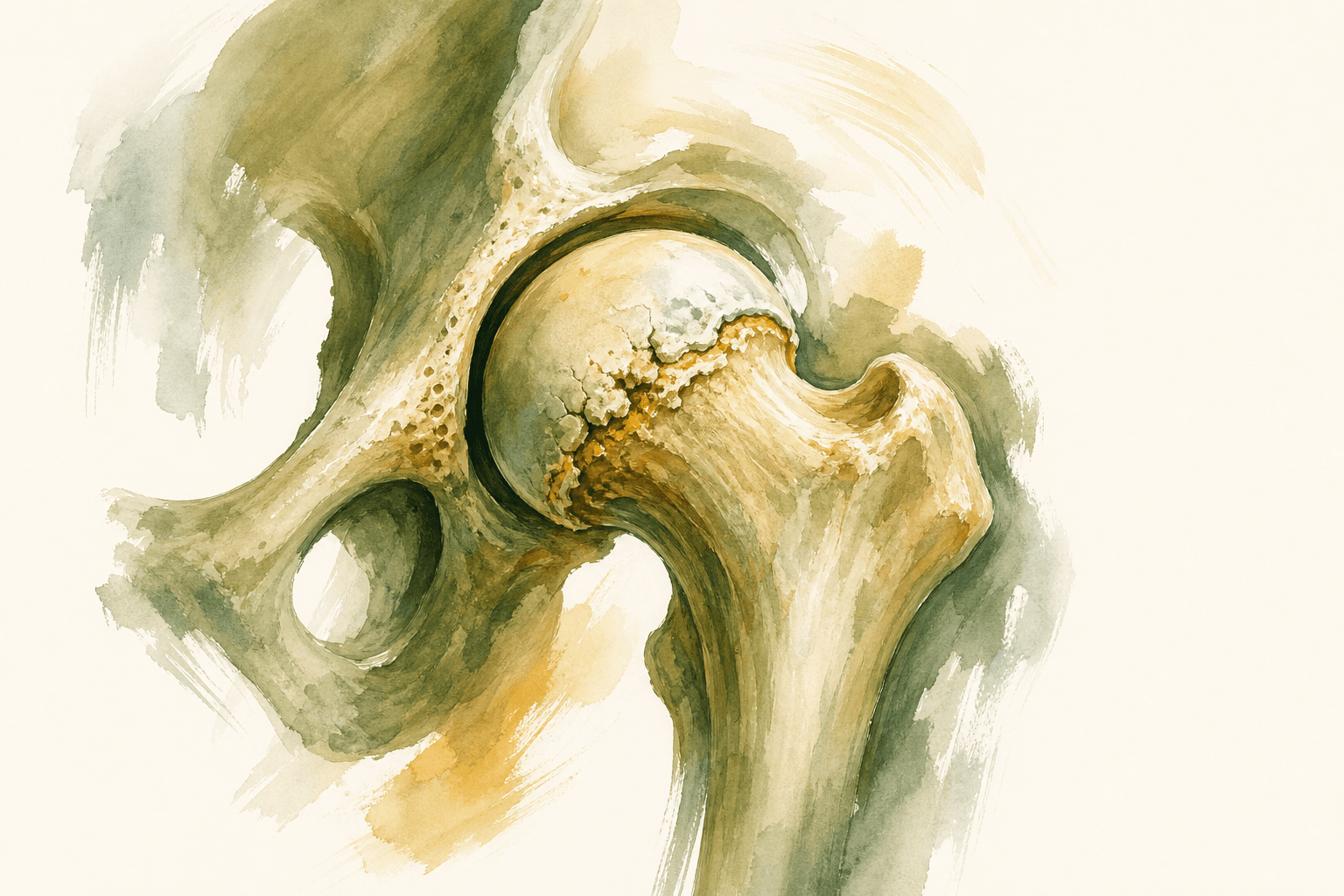
The hip is a deep ball-and-socket joint. Cartilage loss produces mechanical pain and limited motion; AVN is bone death in the femoral head that can collapse the joint if untreated.
Conservative care and injections help many OA patients delay arthroplasty. AVN pathways depend heavily on stage — early disease is where non-arthroplasty options are most often explored.
The standard ladder of care
Conservative care first, then injections, then surgery when indicated. Cell therapy belongs inside that conversation — not above it.
- 1
Conservative care
Activity modification, PT, weight management, and oral meds for symptomatic OA.
- 2
Injections
Image-guided corticosteroid or orthobiologic injectates; core decompression ± adjuncts in selected early AVN.
Autologous cell approaches enter here — dose and donor age are what change the conversation.
- 3
Surgery
Total hip arthroplasty for end-stage OA or collapsed AVN; other reconstructive options as indicated.
Already getting a procedure?
Scheduled for a bone-marrow or fat-based procedure? The collection is the hard part — and yours is already happening. Ask your physician about banking the remainder of your sample with Forever Labs: same draw, no extra procedure, and the youngest cells you'll ever have from this day forward stay preserved for whatever comes next.
Availability
Where this procedure is available
Availability requires both an authorizing state statute and a Forever Labs network physician. Status updates when we publish a provider in Payload — no code change required.
Available now
Florida
Orthopedic authorizationSB 1768 · Ch. 2025-185; Fla. Stat. §§ 458.3245, 459.0127
- Dr. Moises Irizarry-Roman, MD · Miami, Florida
- Dr. Tad DeWald, MD · Miami, Florida
- Dr. Joshua Hackel, MD · Gulf Breeze, Florida
- Dr. Erick Grana, MD · Tampa, Florida
Tennessee
Orthopedic authorizationHB 2246 · Pub. Ch. 1016; Tenn. Code Ann. Titles 63 & 68
- Dr. Ethan Kellum, MD · Franklin, Tennessee
Georgia
Orthopedic authorizationHB 1275 · Act 453; O.C.G.A. § 43-34-49
- Dr. Trevor Turner, MD · Newnan, Georgia
Law open — network coming
Wyoming
SF 0048 — Stem Cell Freedom Act · W.S. §§ 35-4-1101 through 35-4-1106
Forever Labs network recruitment in progress — no committed quarter yet
Physician must be listed on the Board of Medicine registry. Emergency rule in place; permanent rule pending (comments close Nov 13, 2026)
Get notified the moment your state opens
Self-select by geography. We email you when the statute and network status changes — not a newsletter.
Different pathway
These states have regenerative-medicine laws, but not Florida-style orthopedic authorization. Labeled with their actual scope.
Review-board pathway
Montana
SB 535 — Phase 1 safety data + review-board approval required; not condition-specific. No center licensed as of Sept 2026
Right-to-try
Mississippi
SB 2830 — Adult autologous mesenchymal stem cells for eligible patients; not a general orthopedic authorization
Birth tissue only
Utah
SB 199 / SB 55 — Disclosure rules for placental and HCT/P therapies (SB 55, eff. May 6, 2026). Not autologous MSC banking authorization
Not in one of these states?
Banking and shipping are nationwide. Your cells can be shipped to your physician, but the procedure itself has to be arranged with your doctor first.
Browse the full provider networkVerified as of October 13, 2026. Statute claims cite primary sources. Forward-looking network quarters are Forever Labs targets, not legislative promises. Therapies described here are not FDA-approved.
Evidence
Where cell therapy fits
Hip OA regenerative data is thinner than knee. Early AVN attracts mechanistic interest because preserving the femoral head is the goal — still a physician-led decision with evolving evidence.
- 2
- Randomized trials
- 1
- Expanded-cell approvals
- 440
- Largest trial (participants)
The honest read — Same-day products keep landing at parity. The approved products that show more are the expanded ones — which makes dose, not enthusiasm, the variable worth acting on. Receipts in the Evidence Room
- 01
Hip OA injectates face the same dose and potency constraints as other joints.
- 02
Early AVN is often cited as a cleaner biological story than late OA — volume is lower; specialty interest is higher.
- 03
Banking younger cells supports future protocols that may need expanded autologous product rather than a single same-day draw.
The sources
Both directions, cited plainly — the trials that found no advantage and the approvals that show what engineered dose looks like.
- Randomized trialn = 440
MILES
Mautner et al. · Nature Medicine (2023)
n=440 knee OA trial: BMAC, umbilical tissue, and SVF vs corticosteroid — none beat steroid at one year; none moved MRI scores.
- Randomized trial
Shapiro 2017
Shapiro et al. · AJSM (2017)
BMAC vs saline in the same patient's other knee — no difference on primary outcomes.
- Regulatory approvalIndia
Stempeucel
Approved product (India) · Regulatory approval (2020)
Culture-expanded MSC product approved in India — example of dose-enabled products showing clinical pathway beyond same-day unexpanded injectates.
For physicians
Treating Hip? See how practices in our network offer banking and dose.
Reviewed by Tom Nabity, MD. Last reviewed August 26, 2026.
You are your own best donor
The cells you'd want later are the ones you have today.
Mesenchymal stem cells are the population regenerative medicine studies most, and yours are more numerous and more vigorous now than they will be a decade from now. Banking is how today's cells stay available to your physician later. Why dose and donor age are the variable
Your cells, your biology.
Autologous means no donor, no waitlist, and no match required. What we store came from you and goes back only at your request.
Younger cells are more vigorous cells.
MSC counts and proliferative capacity decline with age. Bank at 35 and those cells stay available to the 55-year-old you.
One collection, a larger supply.
Culture expansion is how a single collection becomes more than a single vial. Dose is the variable separating the same-day trials that landed at parity from the expanded products approved abroad. Rolling out as our Florida cGMP lab comes online.
Ready when you and your physician decide.
Your cells stay in cryopreservation until you ask for them. What happens next is a conversation with your doctor — Forever Labs stores cells, it does not practice medicine.
Two next steps — equal weight
Forever Labs does not treat conditions. Your physician owns the clinical relationship. We bank cells and, as expansion rolls out, help make dose possible.