A newly discussed population of cells is generating excitement across regenerative medicine.
Known as MUSE cells (short for Multilineage-Differentiating Stress-Enduring Cells) they have been described as unusually resilient cells with the potential to migrate toward damaged tissue, survive hostile biological environments, and differentiate into multiple cell types.
If those properties are consistently demonstrated in rigorous human research, Muse cells could eventually expand what is possible in regenerative medicine.
But that “if” matters.
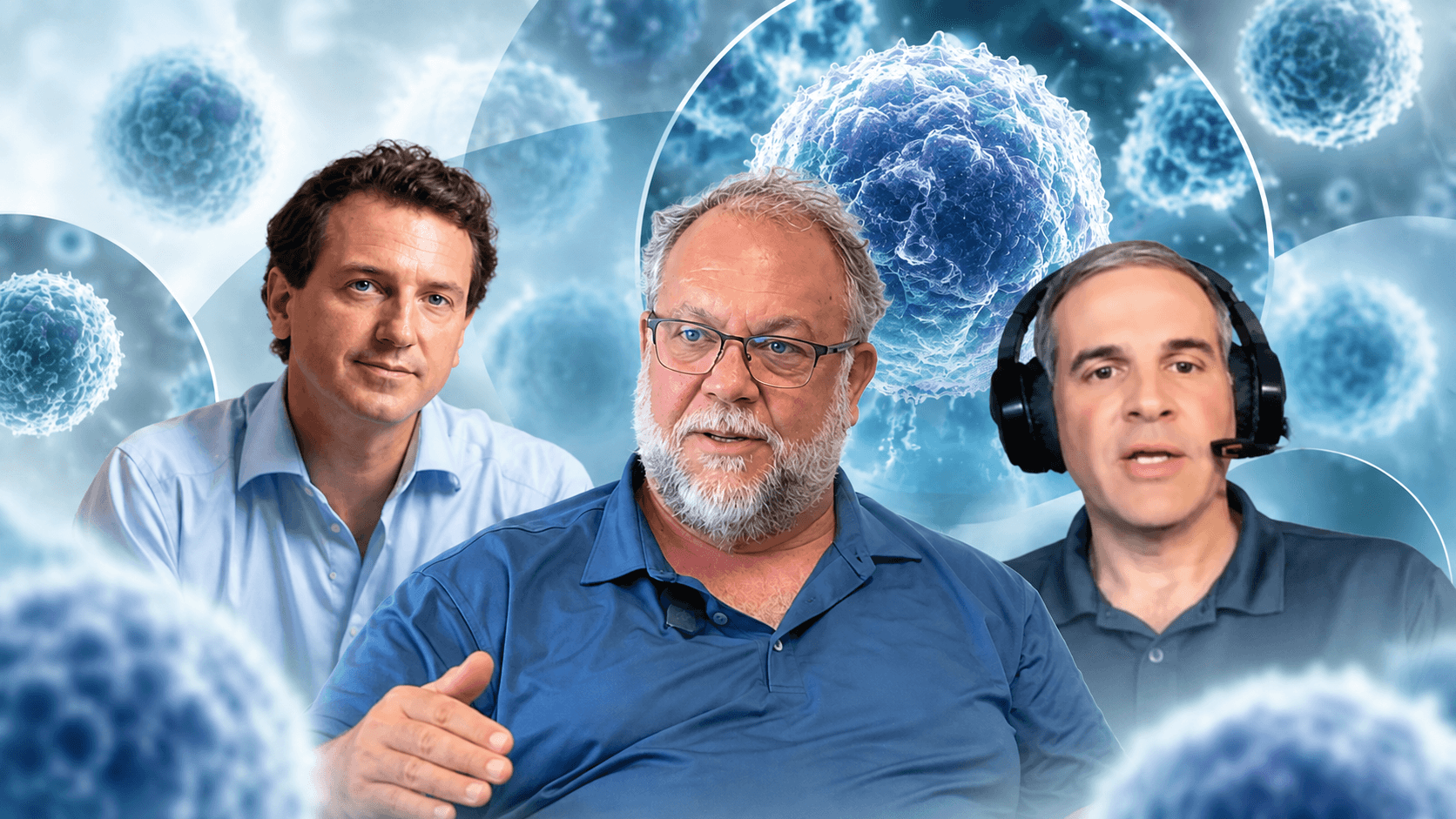
In a new episode of Future Proof with Forever Labs, host and Forever Labs CEO Kevin Virgil brought together three experts with different perspectives on the subject: Dr. Sean Goddard, founder of The Osteopathic Center; Dr. Jeff Chabot, a scientist with more than two decades of experience in regenerative medicine; and Steve Whyte, CEO of AcCELLerated Biologics, and the Regenerative Medicine Training Institute.
Our conversation explored both sides of the MUSE-cell debate: the biological promise that makes these cells so compelling and the evidentiary gaps that make some physicians reluctant to use them.
What are MUSE cells?
The story begins with an apparent laboratory accident.
As Dr. Chabot explains in the episode, Japanese researcher Mari Dezawa and her team were studying cells collected from adult tissue when a culture was accidentally exposed to concentrated trypsin, a digestive enzyme commonly used during laboratory cell processing.
Most of the cells died. A small population survived.
Researchers isolated the surviving cells and found that they appeared to possess several unusual characteristics. They tolerated severe cellular stress, proliferated in culture, formed clusters, and demonstrated markers associated with the ability to differentiate across multiple cellular lineages.
The researchers named them Multilineage-differentiating Stress-Enduring cells—or MUSE cells.
Unlike the simplified public image of a stem cell automatically transforming into whatever tissue the body needs, many cells used or investigated in regenerative medicine appear to act primarily through signaling. They may influence inflammation and coordinate repair without permanently becoming part of the repaired tissue.
Muse cells have attracted attention because early research suggests that they may behave differently. They may be able to migrate toward an injury and, under certain conditions, differentiate into tissue-specific cells.
That possibility is one of the primary reasons for the excitement.
Why are Muse cells so compelling?
Several proposed characteristics distinguish Muse cells from more familiar cell populations.
First, they appear to tolerate significant cellular stress. Their original discovery resulted from their ability to survive conditions that killed most surrounding cells.
Second, researchers have investigated whether Muse cells can “home” to injured tissue after being administered intravenously. If validated, this could reduce the need to place cells directly into a difficult-to-access organ or anatomical structure.
Third, Muse cells have been studied for their apparent ability to differentiate across multiple cellular lineages. In theory, a cell that reaches damaged cardiac tissue, for example, might participate more directly in repair than a cell that only provides temporary biological signals.
Finally, early research has raised the possibility that donor-derived Muse cells may produce a limited immune response. This has contributed to interest in creating standardized, ready-to-use cell products.
Together, these characteristics create an appealing therapeutic vision: an off-the-shelf cell that can be administered relatively simply, locate damaged tissue, avoid immediate immune rejection, and participate in repairing that tissue.
That is an exciting hypothesis. It is not yet a universally established clinical reality.
The evidence problem
One of the clearest points of agreement among the podcast’s participants is that Muse-cell research remains incomplete.
Dr. Chabot, while cautiously optimistic, identifies a major limitation: researchers have explored Muse cells across many different diseases and injuries, but frequently through small or preclinical studies.
Muse cells have been investigated in areas ranging from cardiovascular and neurological damage to liver disease, skin injuries, and other conditions. The breadth is impressive, but breadth is not the same as depth.
A study involving a handful of patients may generate an important signal. It can show researchers that a larger trial is worth conducting. It generally cannot establish how well a treatment works across a diverse population, determine which patients are most likely to benefit, or identify uncommon risks.
The field still needs larger, independently conducted, randomized and appropriately controlled human trials. Researchers also need to demonstrate that the cells used by different laboratories and companies are consistently manufactured and characterized.
Without that consistency, two products marketed with the same name may not necessarily contain biologically equivalent cells.
Are Muse cells naturally occurring—or created by processing?
Dr. Goddard raises another fundamental question: Are Muse cells a naturally existing subset of adult mesenchymal sem cells, or does intensive laboratory processing push cells into a new state?
That distinction could have scientific and regulatory consequences.
Cell expansion requires cells to replicate through multiple passages. Culture conditions, the number of passages, and exposure to different substances can alter how cells behave. If one study uses cells after only a few passages and another uses cells after extensive expansion, researchers need to know whether those cells still possess the same defining properties.
Dr. Goddard argues that identifying the SSEA-3 marker is not, by itself, enough to validate every therapeutic claim associated with Muse cells. Independent researchers may be able to confirm the existence of a cell population with a particular marker while still lacking definitive evidence about its clinical effects.
In other words, proving that a cell exists is different from proving that a treatment works.
When marketing moves faster than medicine
The term “stem cell” is extraordinarily powerful in consumer marketing.
As Steve White points out in the episode, patients may hear about a celebrity or prominent athlete receiving a purported Muse-cell treatment and assume it represents the latest—or best—form of regenerative medicine.
Physicians then face a difficult situation. Patients may arrive requesting a branded or highly publicized therapy before the medical community has reached a consensus about its safety, manufacturing, appropriate use, or effectiveness.
New does not necessarily mean better. A sophisticated scientific name does not guarantee a standardized product. And early encouraging results do not make a treatment appropriate for every patient or every condition.
The responsibility falls on researchers, physicians, distributors, and companies to explain the difference between a scientifically interesting possibility and a clinically validated therapy.
Autologous versus donor-derived Muse cells
The episode also raises an important question about the future of Muse-cell therapy: If these cells eventually become clinically useful, should they come from a donor or from the patient?
Donor-derived cells offer a practical advantage. A standardized product could potentially be stored and made available when treatment is urgently needed.
Muse cells have also attracted interest because early observations suggest they may avoid some forms of immune recognition. But Dr. Chabot highlights an unresolved, longer-term question.
If a donor-derived Muse cell differentiates into a functional heart cell or another permanent tissue cell, it still contains the donor’s DNA. Even if it initially avoids immune rejection, could the recipient’s immune system recognize it as foreign years later?
Long-term evidence is needed to answer that question.
Using a patient’s own cells could theoretically remove this concern. The challenge is scale: Muse cells appear to represent only a small fraction of the cells collected from adult tissue. Producing a therapeutic dose might require isolation and expansion well before treatment is needed.
This is where cell banking could become particularly relevant.
Could cell banking support future Muse-cell therapies?
If researchers demonstrate that autologous Muse cells can be safely isolated, expanded, stored, and used therapeutically, preserving a person’s cells in advance could offer an important advantage.
Time matters in conditions such as heart attack, stroke, and traumatic injury. Waiting to collect and expand a sufficient number of cells after an emergency may not be practical.
A banked autologous sample could potentially provide starting material from which a future therapy might be produced—assuming the necessary scientific, manufacturing, and regulatory standards are established.
This does not mean that banking cells today guarantees access to a future Muse-cell treatment. Muse-cell therapies remain investigational, and many scientific questions are unresolved.
It does, however, illustrate the broader premise behind cell banking: preserving biological options before they are needed.
The responsible conclusion: cautious optimism
The Future Proof panel did not reach a simple verdict—and that is what makes the conversation valuable.
Dr. Goddard remains skeptical and wants to see better cell characterization, independent replication, and meaningful clinical outcomes before incorporating Muse cells into his practice.
White recognizes the market’s excitement but is unwilling to distribute a product without sufficient evidence that it is safe, consistent, and appropriate for physicians and their patients.
Dr. Chabot remains optimistic about the biology and the early signals while agreeing that the burden of proof rests with those developing and promoting the treatments.
Muse cells may ultimately become an important therapeutic platform. They may also prove useful only for certain conditions, through certain manufacturing processes, or in carefully selected patients.
The next step should not be louder marketing. It should be better science.
That means larger controlled trials, independent research, standardized manufacturing, transparent reporting, long-term patient monitoring, and a clear definition of what patients are actually receiving when a treatment is described as a “Muse-cell therapy.”
The promise deserves serious investigation. Patients deserve equally serious evidence.
Watch the complete discussion on Future Proof with Forever Labs to hear the scientific, clinical, and commercial perspectives shaping the debate over Muse cells.
Research Details
Cite this article: . "A New MUSE for Medicine? The Truth About Regenerative Medicine’s Most Talked-About Cell". Published September 22, 2026.